
Deep Tides and Transparent Waters
TL;DR: I am deeply honored to begin my second term. And, I am concerned by a shift in our board’s governance toward consolidated power and restricted dialogue. Despite advance procedural notice of my intent to allow the public to hear the why behind our votes, I stood alone. And, I know that I am not truly alone. A commitment to accountable and inclusive leadership is within our values.
—
I am deeply grateful to everyone who attended the first day of my second term! Thank you. Your support is meaningful and empowering. It was a privilege to be sworn in by the Honorable Judge Ajmeri Hoque, with my family by my side.
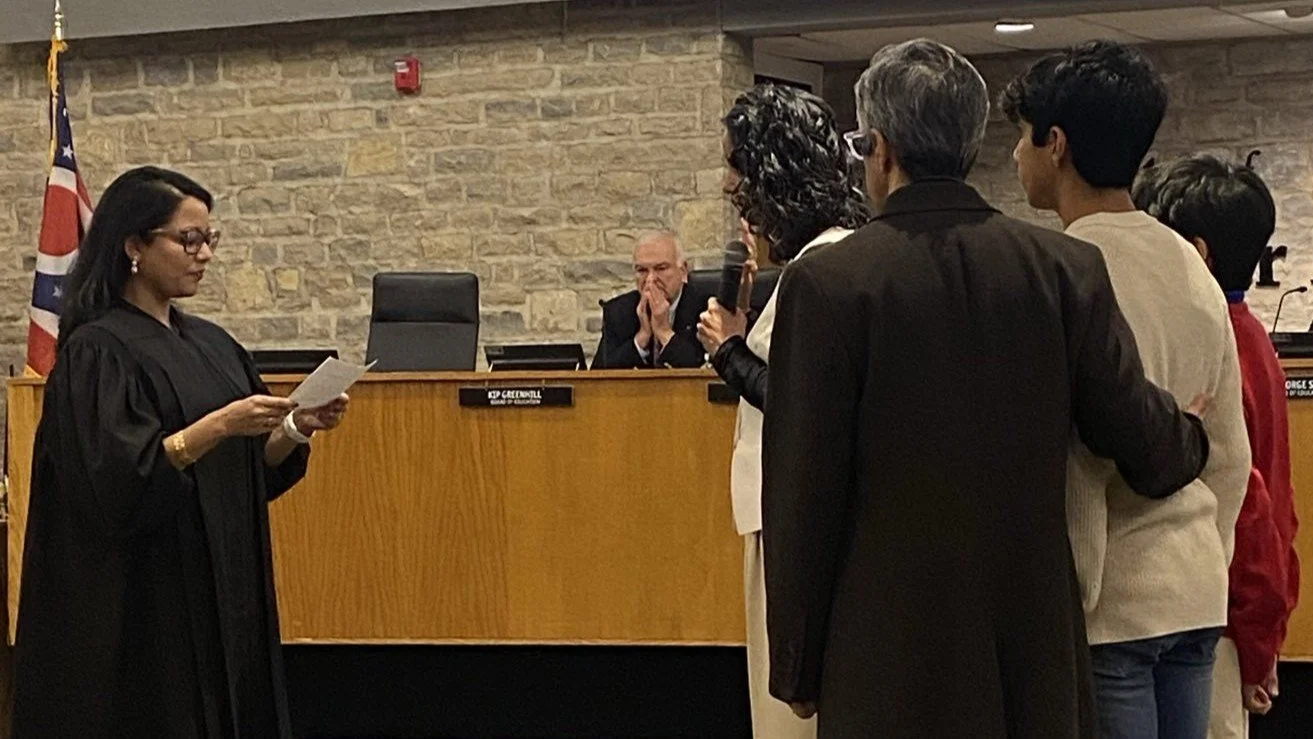
I am proud to have been sworn in to my second term on UA’s Board of Education by the Honorable Judge Ajmeri Hoque.
The “first” cannot be the “only”
Being the first in any position is a unique challenge. We must navigate what has been called the “litigation of legitimacy” in a way that keeps the door open for others like us (1). Judge Hoque is Ohio’s first Muslim judge. Ukeme Awakessein Jeter and I were simultaneously the first POCs elected in UA, to City Council and School Board respectively. While many in UA celebrated my invitation to Judge Hoque, many in UA also litigated her legitimacy. It was telling that community members questioned my choice and our district administration worried about whether she had the authority to do so. I extend grace to those simply trying to ensure we followed procedure. But, clarity on her authority has stood for at least 67 years (2).
As you all know, the litigation of my legitimacy was aggressively pursued in the last couple weeks of campaigning. You may not know that it started the first month I joined the board. And, you likely don’t know that the aggressive tactics from October have continued. While wave 4 is settling and a call for respectful dialogue (starting at 29:53) has been made, I foster no illusions about it being smooth sailing going forward. This is why the presence of Judge Hoque and my friends Dion Manley and Kelli Davis was meaningful to me. As the first out trans man elected and re-elected in Ohio (Gahanna-Lincoln school board), and first Black person elected and re-elected to Worthington’s school board, they understand the additional weight this honor carries and are valuable reminders of why representation matters.
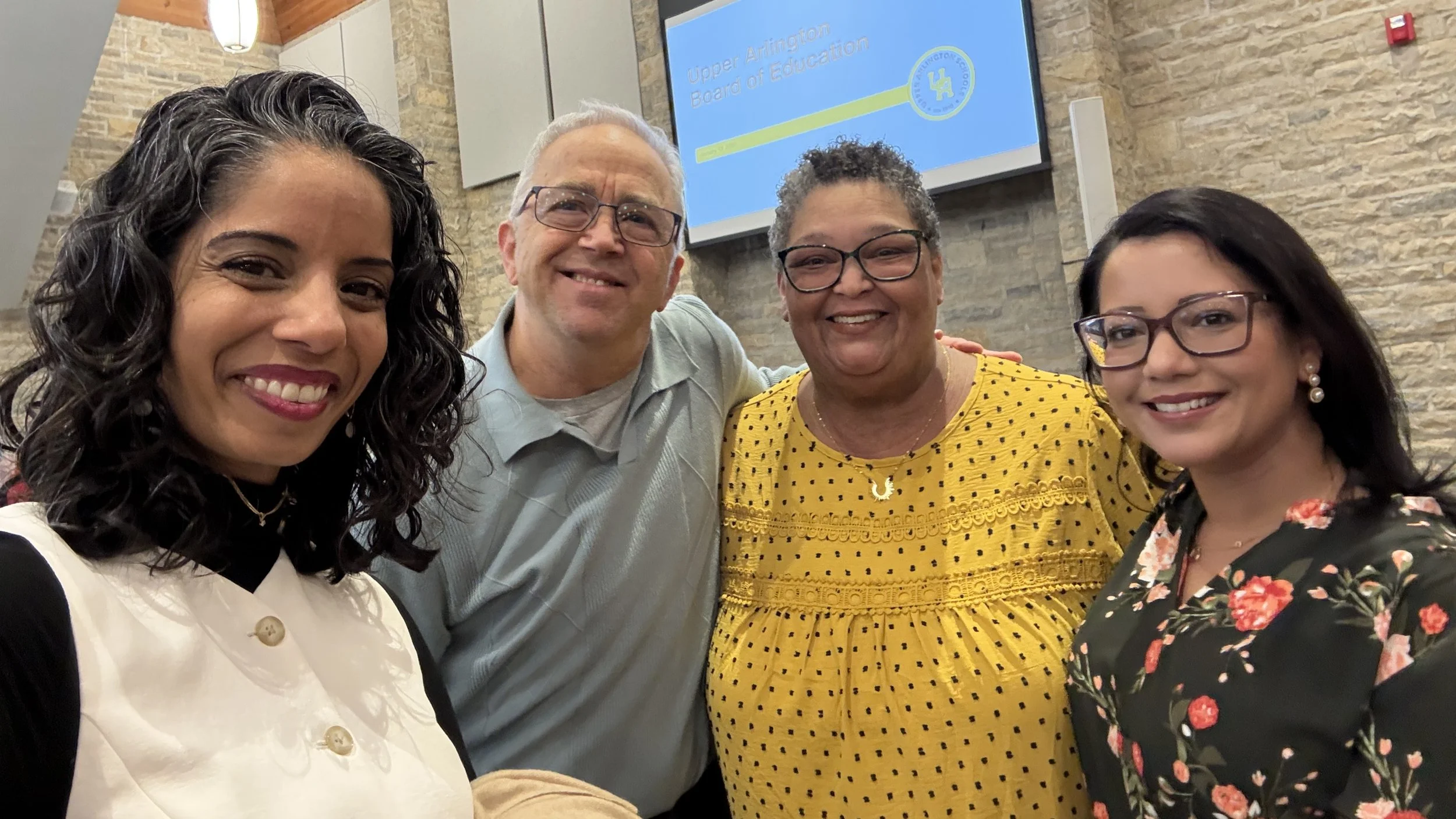
Board Members Dion Manley and Kelli Davis, Judge Ajmeri Hoque, and I are all “firsts” in our roles.
Turning away from democracy
Our community has elected an incredible school board and vociferously rejected all extremist candidates. Our district leaders have said on multiple occasions that we are fortunate that every member is here for the right reasons; we all deeply care about all students.
And, fortunately, we each have different approaches and see different challenges as the primary barriers to student achievement. That healthy tension is not a weakness of democracy; it is one of its safeguards. It ensures no single perspective becomes dominant and no single voice becomes gatekeeper. Difference is not an existential threat. It helps us test assumptions, avoid blind spots, and make more thoughtful, durable decisions than any single approach could on its own.
However, sadly, our local governance is reflecting the same erosion of norms that we see on the national stage:
The Break with Tradition: Our decades long standing practice of rotating board leadership among all members stopped abruptly when it became my turn.
An Increase in Deference: A new pattern of our board president making decisions on their own, without consulting the rest of the board, is emerging. This is not a power granted to them in any law, rule, or policy and is done in the name of “being productive.”
The Shift to Silence: We have moved away from our long standing practice of open dialogue during leadership nominations under the shield of a conservative interpretation of Robert’s Rules. It is being done to present an illusion of consensus.
The Stifled Motion: I provided a one-way procedural notice many days in advance of the meeting indicating my intent to move for open dialogue. My goal was to ensure we could follow policy while still honoring the public's right to hear our reasoning. Unfortunately, no board member even seconded that motion.
A Consolidation of Power: Our board policy says a board president serves a one-year term. Our president has been in leadership for the entire time I have been on our board. She served as our board’s Vice President in 2022, our board’s chair for the superintendent search in 2023, and President in 2024 and 2025.
I want to be clear: my vote for board leadership was not about anything personal. I do not question our president’s kindness or intentions. In fact, I supported her for these past roles and even nominated her for a couple of them.
I voted against a fifth year in leadership because I care deeply about democracy.
As I shared last June, being American is an identity I do not take lightly. I left my 20-year career as an optometrist to become a student of public policy because I worry about the erosion of democratic norms like balanced and informed discussions, respect for opinions and approaches that differ from one's own , regular transitions in power and shared leadership. And, when youth satisfaction with democracy is declining, we must actively and loudly defend the ideals of our Constitution (3).
I, Nidhi Satiani, do solemnly swear that I will support the Constitution of the United States…
I believe the board is stronger when leadership is shared and diverse perspectives are uplifted. I am calling a bluff on “productivity” and “consensus.” They are being used as a polite-sounding cover for silencing people and avoiding democratic accountability. It is an effort to present a calm surface that ignores the rip tide moving underneath. They are prioritizing soundbites over substance because the real work of democracy happens in those tumultuous depths.
Representation is only the first step. For it to have meaning, the institutions we serve must be governed by the very democratic principles they claim to uphold.
I am disheartened by the board’s actions and stood alone in my votes this week. But, I did not feel alone and am not deterred. Thank you for being there physically or in spirit. Democracy is not a spectator sport and is not meant to be easy. And, we can do hard things. I will never stop standing up for the democratic principles that build a strong future for our nation. Our students are watching us. They are learning how to lead, how to disagree, and how to honor the legitimacy of every voice.
Thank you for being part of this journey with me. Let’s keep showing up for one another and for our schools.
Forward together.
At the end of his tenure as POTUS, a lot was written about US President Barack Obama. This sentence in this piece resonates with me: “The litigation of his legitimacy [emphasis added] — of his Americanness — in the end, may have been the blackest thing about the first black presidency.”
ORC 3.24 gives judges the authority to administer oaths, ORC 3313.10 extends that authority to school treasurers, AG opinion 1959-037 clarifies that 3313.10 does not override 3.24, and the AG’s table of previous opinions that have been modified does not list 59-37. This means the clarification has stood since it was issued in 1959 - for 67 years.
Professor Emeritus of Public Policy Robert Reich reminds us that defending the Constitution of the United States means actively and loudly preserving the ideals of democracy